
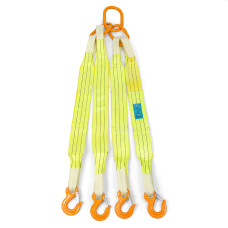
Slings with four legs 4st
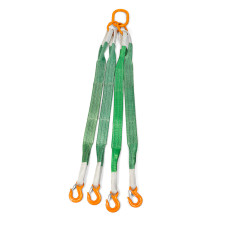
Four-leg sling: advantages of use
A four-leg sling is one of the most versatile and reliable lifting mechanisms used for lifting and moving heavy and large-sized loads. Due to its design, it ensures uniform load distribution, increasing safety and efficiency.
Construction
A four-leg sling consists of the following elements:
- Load branches. Four metal chains, ropes or textile slings that are attached to the load.
- Connecting link. The central element that connects all the branches and provides attachment to the hook of the crane.
- Hooks or grips. Located at the ends of each branch for fastening to the load. Depending on the task, hooks, gripping devices or loops can be used.
- Adjusting elements. Additional elements (for example, tensioners) that allow you to change the length of the branches for uniform load distribution.
Advantages
- Uniform load distribution. Thanks to the four branches, the load weight is evenly distributed, which reduces the load on each individual branch.
- Versatility. The 4-branch sling is suitable for lifting loads with an asymmetrical center of gravity, as well as for working with large and non-standard structures.
- Reliability. Four-branch slings are made of durable materials (steel, textile or combined fibers), which ensures their durability and resistance to tearing.
- Safety. Additional mechanisms, such as latches on the hooks, prevent accidental disconnection of the load.
- Wide range of lifting capacities. Four-branch slings are used to work with loads weighing from several hundred kilograms to tens of tons.
Manufacturing materials
- Steel ropes. They are characterized by high strength and durability. They are used to work with heavy loads in difficult conditions.
- Chains. They are used in heavy industry and construction. They are resistant to mechanical damage and high temperatures.
- Textile slings 4st. Made of synthetic fibers (polyester, nylon). They are lightweight, flexible and safe for working with delicate or painted surfaces.
Application
- Construction. A four-legged rope sling is used to lift concrete blocks, metal structures, scaffolding and other elements.
- Shipbuilding. They are used to move heavy ship parts, including hulls, engines and other equipment.
- Mechanical engineering. They help lift large parts, machines and mechanisms.
- Warehouse logistics. They are used to move large loads, such as containers or large consignments of goods.
- Mining industry. They are used to transport equipment, materials and products under high loads.
How to choose the right option?
- Choose a 4-legged sling with a reserve of lifting capacity to avoid overloading.
- For fragile or painted loads, it is better to use a 4-legged textile sling, and for heavy loads - a steel or chain sling.
- Consider factors such as temperature, humidity and exposure to aggressive environments.
- The length of the branches should be sufficient to securely fasten the load. Adjustable length branches provide ease of use.
- Pay attention to the presence of certificates confirming the product's compliance with international safety standards.
Operating rules
- Before use, check the sling for damage (tape wear, chain corrosion).
- Make sure that all branches are properly fastened and that there are no twists.
- Distribute the load evenly to avoid overloading individual branches.
- After work, store it in a dry place protected from damage.
In conclusion
Four-branch slings are indispensable tools for working with heavy and large-sized loads. Their design ensures reliability, safety and versatility in various fields, from construction to logistics. Choosing the right option and following the operating rules guarantee the successful completion of tasks of any complexity.